Social Co-Occurring Disorder Recovery
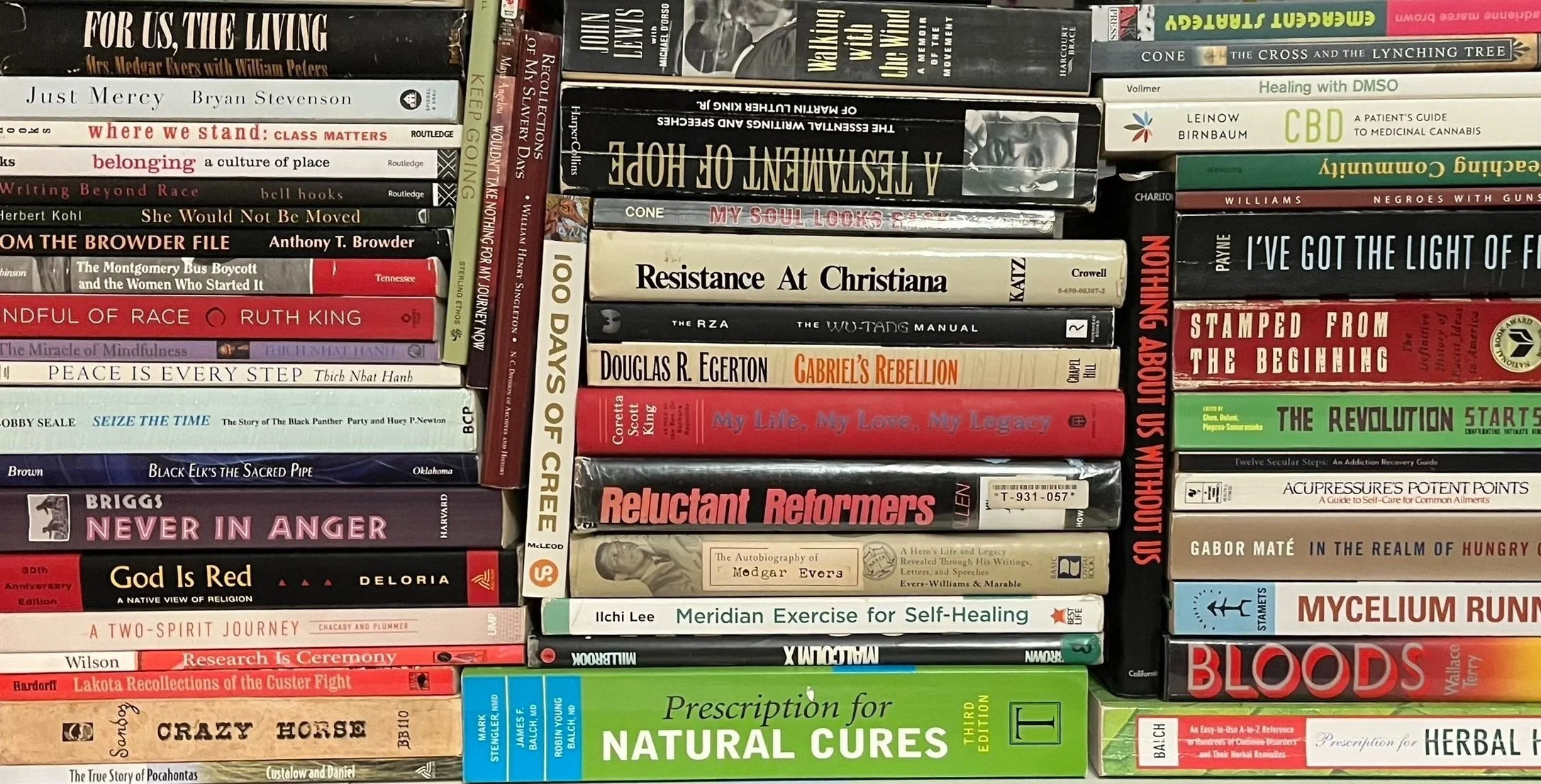
bell hooks helps us to name the environment; white supremacist capitalist hetero patriarchy and makes the point in Writing Beyond Race that “To live the practice of anti-racism no matter the color of one’s skin you must dare to make all the environments that you design and control places that maximize your well-being.”
Dr. Martin Luther King focuses us on the interweaving social ills of racism, economic exploitation, and militarism. When writing about the French and Americans invading and occupying Vietnam Thich Nhat Hanh suggests the breakdown of their society and increase of violence began centuries earlier when Roman Catholic missionaries first arrived in Viet Nam.
Social Co-Occurring Disorder Recovery (SCODR) identifies social conditions as co-morbid and life threatening. SCODR is inspired by the work of Paulo Friere, bell hooks, Gabor Mate, Ella Baker, Septima Clark, Fannie Lou Hamer, the Highlander Research and Education Center, SNCC, Alcoholics Anonymous, Idle No More and First Nations culture and cosmologies, the Young Patriots and Black Panther Party, spiritual leaders such as: Thich Nhat Hanh; Sitting Bull; Dr. Martin Luther, Coretta Scott and Dr. Rev. Bernice King; Clarence X; Betty and El Hajj Malik El Shabazz (Malcolm X); as well as peer support successes in mental health and substance use and recovery.

Programs
-
A Bible, some Bud, and a Brew.
“For these are not drunken, as ye suppose; seeing it is but the third hour of the day;” - Acts 2:15
Bible Study and peer support for mental health and substance use with your own herbal and cannabinoid (CBD) healing and non-alcoholic brews, coffee and teas. Classroom 3B seeks to destigmatize cannabis use for the treatment of disease and well being and to promote harm reduction and coping skills. Biblical perspectives are rooted in Black Liberation Theological, womanism, Queer Theology and Decolonizing Christianity.
-
The road to De Mask Us: Law enforcement and military transformation support.
9 Meanwhile, Saul was still breathing out murderous threats against the Lord’s disciples. He went to the high priest 2 and asked him for letters to the synagogues in Damascus, so that if he found any there who belonged to the Way, whether men or women, he might take them as prisoners to Jerusalem. 3 As he neared Damascus on his journey, suddenly a light from heaven flashed around him. 4 He fell to the ground and heard a voice say to him, “Saul, Saul, why do you persecute me?” Acts 9
-
Inspired by Viet Nam veterans that created their own successful clinics for addiction and post traumatic support, GI Junkies welcomes all in recovery or suffering from addiction and mental health.
-
Religious Trauma Recovery. Many of us have been harmed in relation to churches, churchgoers, and religion. In personal and political ways the pain and trauma runs through our bodies and generations of bodies. Believers and non-Believers, doubters, haters, agnostic and atheists, church elders and new converts: there is someone carrying some baggage that you’ve never even seen. Holy $h!#! brings people together to tend to our wounds through the power of witness, listening, reflection and testimony.
-
Peer support and resourcing for unsheltered people, chronically homeless, and formerly homeless neighbors.
-
on·to·log·i·cal adjective. 1. Relating to the branch of metaphysics dealing with the nature of being.
What does it mean to be fully human? What are the barriers and needs to accessing your personal calling and a healthier life? Grounded in Paulo Freire’s Pedagogy of the Oppressed, Ontological Voc Rehab uses a popular education and communal approach towards the concepts of healing, education and occupation.
-
Legal Aid peer support. Going through the legal system; family, criminal or civil can be taxing and triggering. Poor people, those with diagnosed mental illness or Disabilities may experience further alienation, discrimination, and traumatization from the Justice system. Not to mention the harm by prior abusers, children being taken, or implicit bias in attorneys, expert witnesses and court officials. Peer se looks at your case and health concerns and aims to create a plan that supports your wellness and wisdom during your Court involvement.
-
Bobby Seale founded the Black Panther Party after working for some time with youth and on poverty in his community. What can we, as people living with PTSD and mental illness, learn from the Black Panther Party? Can the lessons of the Black Panthers improve our health? What histories of the Party have been hidden and manipulated so as to hide these lessons? Using historical documents, writing, art, and media we engage and honor the legacy of freedom and community uplift.
-
Veterans Anonymous “the VA” is a fellowship committed to the demilitarization of our bodies, relationships, and society so that we may help ourselves and others recovering from war, militarism and military enlistment or transition.
The VA seeks to destigmatize and reorient identities beyond unhealthy labels like veteran, combat vet, disabled vet, broken vet, and crazy vet. Using an Alcoholics Anonymous framework, the VA seeks to expand recovery and healing opportunities for veterans, dependents, spouses and caregivers.
-
White Supremacy Anonymous is a fellowship dedicated to challenging white body supremacy so that they may help themselves and others recover from racist thought, belief, speech and actions. The only requirement for membership is a desire to challenge white body supremacy.
What’s the story?
I have been in treatment, recovery, and social justice programs or communities for nearly 20 years. My experience with activism taught me that social activist organizations and individuals can be just as harmful and abusive as normative systems of behavior and control. Many experiences in recovery and treatment were not rooted in justice or liberation. My experience as a poor and Disabled person has been one of limited access and incredible amounts of stress that non-poor people are not dealing with in their day-to-day lives. The lacking and the benefits of these experiences are largely where I draw from in creating Social Co-Occurring Disorder Recovery Programs.
I consider myself to have been in active recovery for White Supremacy since 2006, and while I may not have been a ‘user’ of racism it was active in my system in the way the descendant of a “dry drunk” may have that disease in their system. Challenging my own beliefs, knowledge, and input regarding White Supremacy has been just as crucial to my healing as specific trauma processing. And challenging White Supremacy added resiliency and critical thinking in ways that would not have surfaced had I been in solely traditional types of recovery programs.
I have experienced mistreatment and abuse through Church, varied forms of child abuse, death and loss as a result of tragic illness and suicide. I have experienced varied traumas and chronic mistreatment through the Marine Corps and as a veteran. I have witnessed a homicide and my son was in the hospital his first almost 4 months of life and wasn’t predicted to survive. All of these have informed my life and recovery journey. My life is trauma informed, probably like yours. While I applaud trauma informed care efforts, I needed Black Liberation informed care. I needed Lakota recollections and Indigenous perspectives informed care. I needed artistic and culturally and feminist informed care. I needed activists to stop going the pace of White Supremacy and Ableism.
Several years ago I co-facilitated workshops in a co-occurring clinic at two military hospitals. The clinic was for active-duty personnel and veterans with a dual mental health and substance use diagnosis. These experiences and the relationships with participants is a major inspiration for Social Co-Occurring Disorder Recovery. Many participants that had been hospitalized for some time would repeatedly say “this is the only thing that helps me” in regards to our workshops. The stories I was beholden too was a weight that most Americans cannot comprehend. Being punished by a commander and reassigned to the Hospital as a duty station. Being punished for a suicide attempt. Being forced to take certain medication and being punished for the side effects of the same medication. The workshops we hosted were low-key writing and art making workshops. We had two writing groups each day, and paper-making. The paper-making was a traditional method and we used military uniforms to make the paper. Cutting up military uniforms, your own or others, can be a charged experience. We used poems as prompts to a free writing session with the option to share afterwards. These were week-long workshops with participants coming Monday - Thursday with an art show and reading culminating at the end of the week. Most of the other facilitators and I came out of a Veterans anti-war and organizing tradition. While we were not in that role going into military hospitals we still experienced the tradition with the hospitalized troops and veterans we met. Rather than a political action, we wrote, cut uniforms, made paper, and shared art. Trying to convince other veterans to join an anti war movement could be challenging if not impossible. But give me a room with some poetry, paper and pens, and some vets; within a few days nearly the entire room would be anti-war, more tolerable of differing viewpoints and personalities, spitting dope poetry even if they’ve never wrote, and the grip of PTSD would visibly loosen in bodies and personalities throughout the week.
I believe this type of healing, loosening, expression and recovery can occur in poor communities and across socio-economic lines if the access and opportunity is there.
My hope with SCODR is to grow through publications and recovery guides, expanding group leaders and facilitators, and begin hosting programs locally and online. If you are interested in participating or starting a local group meeting please get in touch!